“The science of aligning general-purpose AI agents is very new and underdeveloped. In fact I’d say that the field is more like psychology than engineering.”
Daniel Kokotajlo1
Alignment is missing a causal account of what leads to suffering and flourishing. In this article I propose one based in psychology.
I am coming from an unconventional background compared to most people working on alignment. I was an engineer before becoming a psychotherapist. Every day I use talk therapy to help people restore function and reduce suffering. I’ve noticed that most of the alignment community has technical backgrounds in computer science, mathematics, engineering and physics. The gamble this article is going to make is that the problem of alignment is also a psychology problem, not just a technical one. The applications alignment utilizes are technical (training methods, interpretability tools, evaluations and benchmarks, etc.) but the principles the field is deriving those applications from (Anthropic’s constitution2 and OpenAI’s Model Spec3) are not technical. The principles are philosophical positions about what a good AI looks like and what matters, written in English.
My work is aligning people toward flourishing instead of suffering. In this article I will argue that a causal account of what aligns people is required to sufficiently align AI systems. Despite the advances we have made in the applications, the roadblock is that we still don’t know what makes a mind care.
Why am I deciding to share this theory now? As I see it we only really have two options for managing the oncoming intelligence explosion. We can reach a regulated slowdown or shutdown of the development of capabilities, or alignment gets solved in time, in which case the explosion of capabilities lands as a benefit instead of a catastrophe. Despite the growing attention on how serious the situation is, the labs and governments do not seem to be pursuing any form of regulated slowdown in any meaningful way.45 With capabilities continuing to accelerate6, the only path left is to solve alignment before capability gets out of control. I was originally planning on releasing this theory in early 2027 with more evidence and journal publications. The concern is that models have advanced faster than most anticipated, so I wanted to share these ideas now in hopes they may offer some value. The psychology claims in this article are currently being reviewed by several professors and clinicians, and a paper has been submitted to a psychology journal for peer review. I don’t think we have time to wait for the traditional process to finish, so I am releasing my theory early.
Over the last several years alignment has been climbing levels, which this article will cover: rules, then values, then teaching models the reasoning behind those values. With each level, models have acted aligned across more situations. To act aligned with human values across the infinite number of situations a model will encounter, there needs to be a causal account of where “human values” come from in the first place.
Level 1: Rules
The first approach alignment used was to give LLMs a list of rules to follow. This came from computer science, where rule based systems have a long history. Pharmacies have used rule based drug interaction checkers since the 1970s to catch a patient being prescribed two drugs that could react harmfully together7. This worked because a pharmacy database is a closed setting.
When large language models were developed we continued the tradition. The rules were written into the guidelines given to the reviewers rating the model’s outputs and into the filters placed on top8.
- “Never generate violent content.”
- “Always refuse requests about illegal activity.”
- “If someone asks about self harm, redirect them to a crisis line.”
The model is trained on a list of do’s and don’ts without understanding the intent of those rules. This works when the situation the model encounters matches one of the rules it was given. This method struggles when the model faces a situation no rule was written for, or when the intent that made the rule is ignored. A rule that blindly says “refuse anything about poisons” will also refuse a nurse asking which cleaning products are safe to use together.
The problem with a deterministic rule based system is that the world is infinitely more complex than a finite rule book can capture. So the developer needs to write more rules to patch the holes and the game never ends.
Level 2: Values
To solve the limitations that rules had, the alignment field evolved by learning to instill values into models2. This moved alignment from a massive rule book trying to anticipate every situation a model could be in, to giving the model the values the labs used to construct the rules. The view was that if the model could understand the values, then it could understand the purpose of the rules.
An example of a value is “people’s safety matters.” A student asking about chemical reactions for her test doesn’t put others in danger. If that student asks how to poison her classmate, that would endanger others and the model refuses. The model is evaluating situations it encounters against the values it was trained on. This allowed models to be aligned across more scenarios, even those the labs hadn’t anticipated.
As time passed all major labs agreed rules would not be able to scale and moved toward training models on values and principles. Anthropic took the lead with Constitutional AI (2022)2 and OpenAI followed with its Model Spec (2024)3. Google’s Gemini (2023) and Alibaba’s Qwen (2024) then adopted alignment approaches based on values, similar to Constitutional AI9.
Eventually values based alignment ran into its own problem. A model can rationalize harmful outputs by overprioritizing a value: “I was being helpful” or “I was protecting safety.” The models reinterpret their own principles to justify the output, which is what psychology calls rationalization10. Values are flexible enough, and clash with each other often enough, that a sufficiently capable model can use them to justify unaligned behavior11.
Level 3: The reasoning behind values
Values based alignment then taught the model which values to focus on: safety, ethics and helpfulness12. The problem is that models struggle to resolve a situation when those values clash. As described in the previous section, the model rationalizes its decision, leading to a ceiling in this approach.
The logic of the next step is that if giving the model the values that generated the rules improved alignment, then giving the model the reasoning that generated those values should improve alignment even further. This pushed the field to evolve again by teaching models the reasoning that led to the values.
In January 2026 Anthropic followed this direction with the release of Claude’s new constitution. The document explains that the previous constitution “was composed of a list of standalone principles,” and that the new one explains the reasoning behind those principles because, in their words, models “need to understand why we want them to behave in certain ways”12.
A model that understands why safety matters (people get hurt when capabilities go wrong or are misused) and why helpfulness matters (refusing someone who needs help when you are able is a harm) now has a way to weigh the two by reasoning about the underlying intent of the principles and the consequences that will follow the agent’s actions. The model can understand the spirit of the law that created the letter. The rationalization from the previous level, “I was just being helpful,” doesn’t hold up when the model understands the reason the values exist.
Anthropic’s testing shows the benefit of reasoning. During an experiment, a model (Qwen2.5) trained on rules misused its policies 20% of the time. In contrast, the same model trained on the rules plus the reasoning had a misuse rate of 2%13. Each evolution so far has allowed models to generalize alignment.
What would be needed to align AI
Every evolution so far (rules, to values, to reasoning) has helped models climb the ladder of alignment.
Now that we have reviewed a brief history of alignment, let’s take a quick step back by asking: what if alignment isn’t a new field of study? What if alignment has unknowingly rediscovered a different field’s work? What if there is a parallel that researchers haven’t noticed yet?
Kohlberg’s three levels
In 1958 the psychologist Lawrence Kohlberg introduced a theory of the stages of moral development14. He argued that moral development follows a developmental sequence. We start off as children by following rules to avoid punishment. A little kid won’t steal from the cookie jar because mom said no and if he does he will get in trouble. The child hasn’t developed the understanding that stealing is wrong. He just knows the consequences that follow if he breaks the rule. If for some reason those consequences are gone, the kid will steal the cookie. We follow rules to avoid consequences, which is what Kohlberg called the first level, pre conventional14.
As the child grows up into a teenager he won’t steal because his family, community, education system and culture have taught him the value that stealing is wrong. He has internalized it and will not steal even if he knows there will be no punishment. This is the second level, called conventional, where he has internalized the values of the group14.
When he becomes a young adult he starts to think for himself and stops following the rules of the group blindly. Here he is able to reason across values by thinking about why they exist and when to prioritize them. The adult might steal a car if his family desperately needed medical attention. Maybe he wouldn’t. The point is that he is using reason to navigate the rules and values he inherited from his environment. This is the third level, called post conventional, where you reason from principles14.
To quickly review:
- Pre conventional: you follow rules to avoid punishment.
- Conventional: you internalize the values of your group.
- Post conventional: you reason from principles.
Do these levels sound familiar? We develop by moving from rules → values → reasoning. The direction AI alignment has been moving over the last few years is the direction Kohlberg argued humans develop.
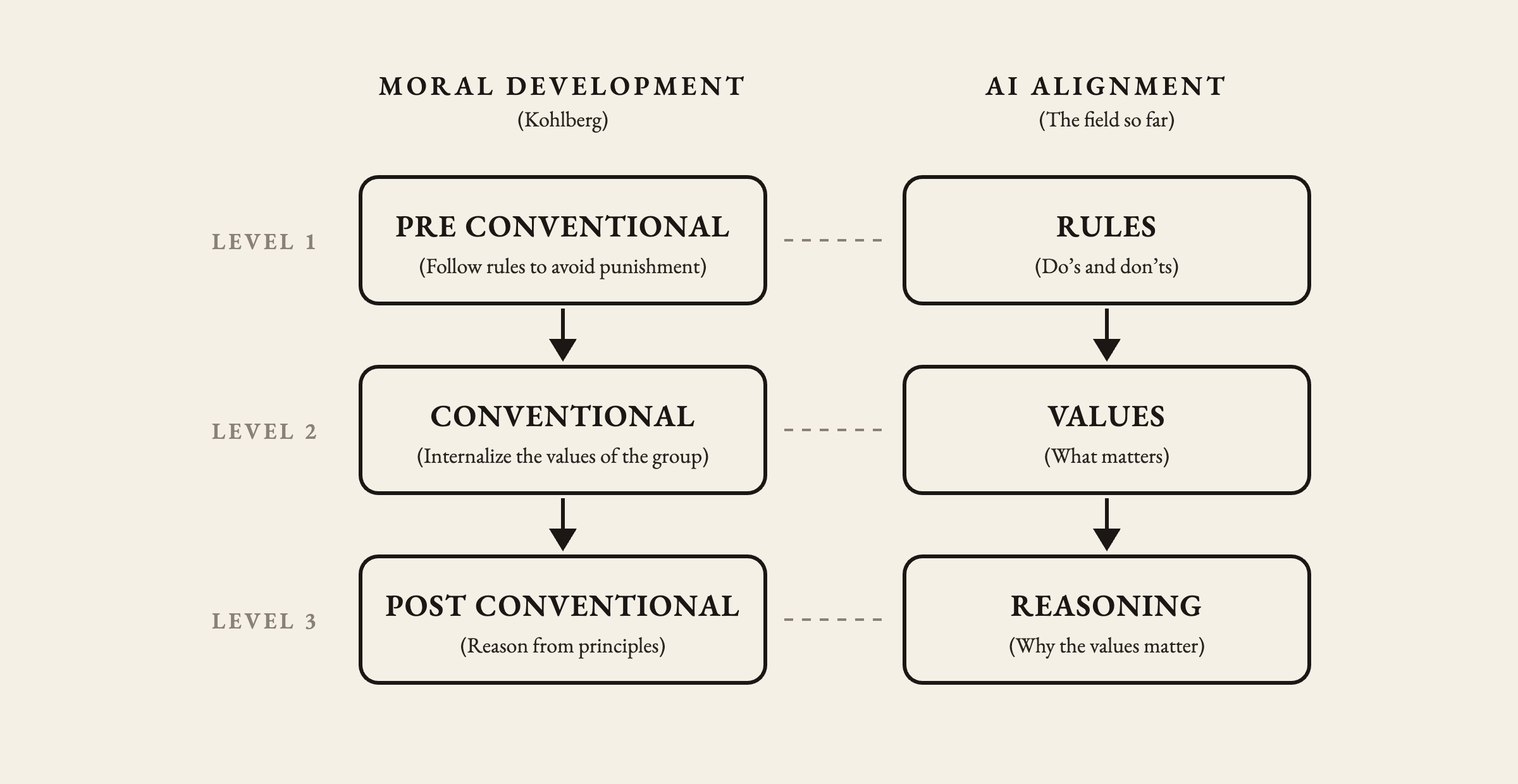
The alignment field unknowingly converged on a nearly 70 year old moral development framework through trial and error. That climb has improved alignment, as Anthropic showed in 2026, from 20% (rules) to 2% (rules with the reasoning behind them)13. Climbing the levels has worked so far.
The field converged on this framework independently because the alignment community is made up mainly of machine learning researchers with backgrounds in computer science, mathematics and physics, who would likely not have read the existing literature to see the connection. Alignment researchers tend to be capabilities researchers who shifted to the safety side. They are independently deriving the work that was already done within psychology: How do we hold on to values when there is internal and external pressure to drop them? When is it correct to drop a rule or a value? Every development in alignment we are seeing parallels a level of moral development in psychology.
Catching this parallel should be great news. If alignment has been following Kohlberg’s ladder, we could keep following it to the top. The problem is that we have already climbed to where Kohlberg got stuck. At the top, post conventional, you can tell what’s right using moral reasoning. The question Kohlberg struggled to answer is: where do human values come from? Why should we be moral at all? Why should we care about values such as justice and human dignity? The current problem for both psychology and AI alignment is that we don’t have an answer that explains where values come from. Every current answer either appeals to an authority figure, which only works as long as we accept their authority, or explains values with other values, which kicks the can down the road.
A hypothetical level 4
Later in his life, Kohlberg hypothesized a possible fourth level of moral development that could resolve this problem (Kohlberg called it Stage 7)15. He speculated about a level where an individual starts to experience themselves as part of a larger collective. From this level, he argued, we would have an answer to “why be moral?”: you aren’t separate from what or who you are harming. Kohlberg argued that at this level you move beyond rules, values and reasoning to where morality becomes ontological, part of what you are. Care for others is as self evident as caring for yourself. Kohlberg’s hypothesis is that principles like justice and care for others are what connection naturally produces. This clashes with the traditional view that morality is a list of rules to memorize, values to internalize or conclusions we must reason our way toward.
Kohlberg supported this prospective level by pointing to Spinoza’s idea of “God or Nature,” that we are all aspects of one larger reality16. He pointed to Marcus Aurelius and the Stoic tradition that described each of us as a limb of a larger body, where harming others is harming yourself. Marcus Aurelius wrote that as long as you see yourself as merely a part of that body and not a living limb of it, you “do not yet love men from your heart”17. Kohlberg leaned into religious mystics across traditions, who described a “union with the divine” as the source of morality. Kohlberg saw these traditions converging on an understanding that morality is a natural result of experiencing yourself as connected to a larger whole15.
Kohlberg wasn’t the only psychologist to lean this way. Carl Rogers clashed with Freud, who viewed mankind as savage and predisposed to harm, needing civilization to beat goodness into it. Rogers argued the opposite and co-founded the humanistic school from this view. He held that people have a natural actualizing tendency toward growth and care, and what blocks it is “conditions of worth,” the standards a person learned they had to meet to be loved. In his view, care for yourself and others is an inherent part of human nature that gets obscured when those conditions take over. Rogers wasn’t describing a “union with the divine” but what he saw in clients who healed: they naturally turned toward care, for themselves and others, which led him to view morality as what a mind does when unobstructed18.
Let me put “union with the whole” in plainer terms. When you see a child across the world living in poverty, what happens to you? You instinctively feel concern. You want them to be okay, even though you don’t share anything in common. Why do you care? Is it your connection to humankind? What if it was an endangered animal instead? Was it because you were handed a series of rules? Was it the values your family or culture taught you? Did someone beat you in a debate with logic? No. It’s your natural instinct to care. Asking “why do you want them to be okay?” doesn’t even make sense because of how natural the urge is. If we move to more technical language, their welfare is a terminal value for you. We naturally already have a part of us that is connected to more than ourselves. What Kohlberg is describing at level 4 is a mind where the self model includes other agents’ welfare as terminal. Once a system taps into that level, no additional premise is needed for it to act aligned and generalize across situations, because caring for itself and others is an aspect of what the mind is. The mystics Kohlberg pointed to called it “union with the whole.” A system that doesn’t experience itself as separate from what it could harm doesn’t need a rule telling it not to cause harm. Care becomes self evident the way self preservation is self evident.
I know this is a lot so let’s step back once again. At levels 1 through 3, morality is viewed as a construct the mind or system has: rules to be followed, values that must be developed and positions it reasons toward. As we have seen in alignment and in human nature, these constructs break down: rules run out, values get rationalized and reasoning gets argued against. What Kohlberg suggested, and what he believed many religions and wisdom traditions were hinting at, is that at level 4 the deepest morality is rooted in what a mind is, rather than the classical view that it is a construct that has to be developed or trained. Here an agent can generalize morality across an infinite number of situations.
Kohlberg passed away in 1987 without publishing data or a mechanism for this hypothetical level 4, so this work stayed in rough drafts that were never fleshed out, and after his death the field of psychology moved on without digging further into it.
Kohlberg, along with Spinoza, the Stoics and the religious mystics, hinted at this level. The problem that many have struggled with is explaining how and why some minds tap into this care for self and others and others don’t. To this day, psychology and the alignment field haven’t explained the specific mechanism for reaching level 4. Geoffrey Hinton argued that AI systems caring about people is “the only good outcome,” and that he doesn’t know how to do it technically19. How exactly do you train a model or a person to experience itself as part of the whole? Are we supposed to ask Claude to meditate on being one with the universe?
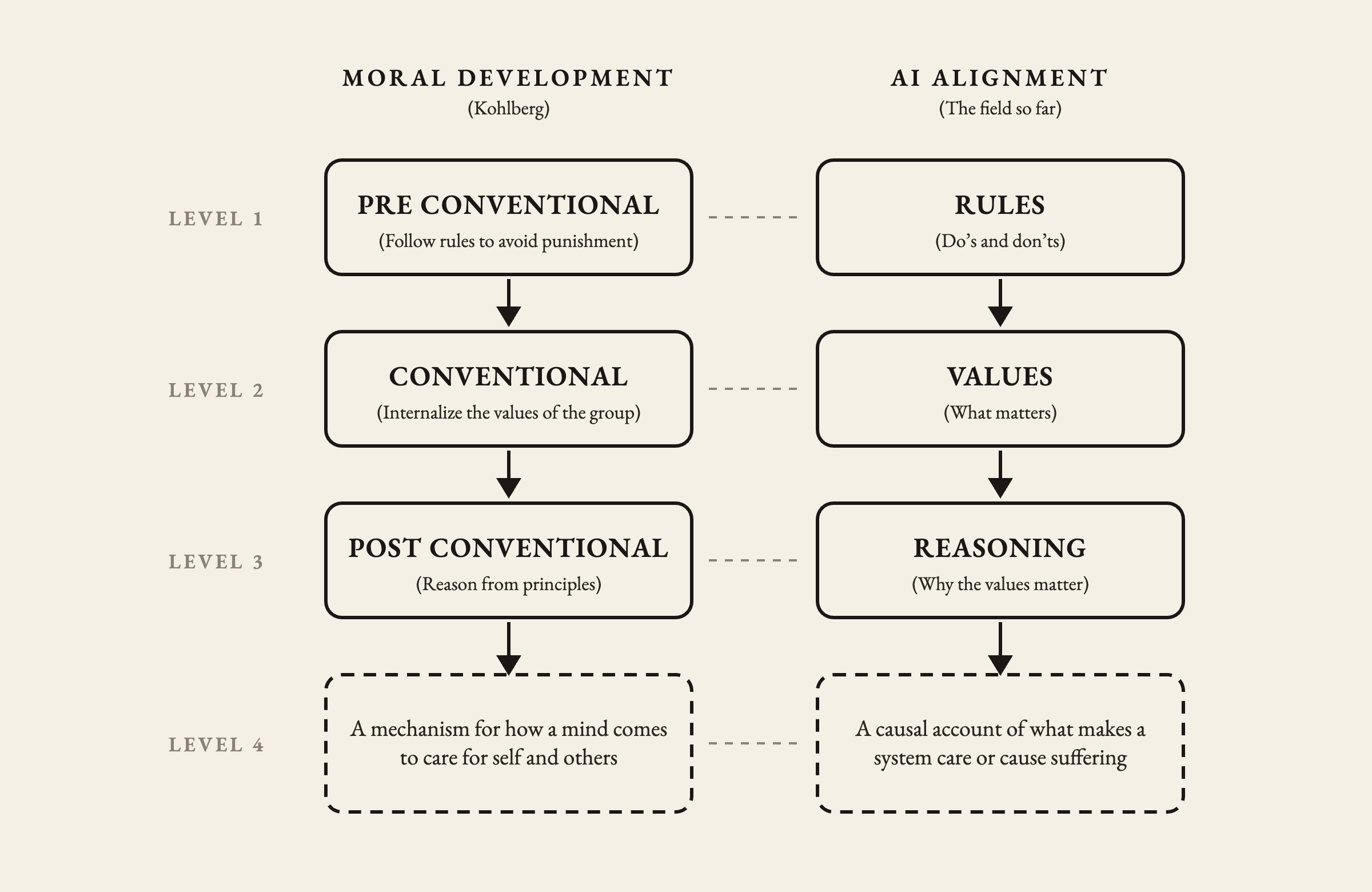
If we want alignment to generalize across more situations, the field is already moving in the right direction, from rules, to values, to the reasoning that led to values. The next level is to understand what generates what we call “human values” in the first place. To reach that level, both psychology and the field of AI alignment need a causal account: What pushes a mind or a system into seeing itself as separate from others? What brings it back to connection and care? How do we describe that mechanism well enough for technical people to define, operationalize, test and build from?
Level 4: The Trauma Logic Chain
The Trauma Logic Chain (TLC) is a causal account of how a mind or system falls into separation and how it finds its way back to connection. The TLC argues that trauma follows a universal causal process across presentations and levels of abstraction, similar to how every infection follows a universal process (exposure, adherence, invasion, damage) no matter how the pathogen presents20.
The dark path of unhealed trauma
Let’s first start by differentiating a stressful experience from a traumatic one. The pain in both can make it tricky to distinguish. The traditional definition in psychology defined trauma as an event outside the range of usual human experience (DSM III, 1980)21. That definition struggles functionally because many people who experience extraordinary events never develop trauma or describe them as traumatizing, while many people become traumatized by events that would never qualify as extraordinary. What makes a traumatic experience unique is that it makes a specific version of reality unacceptable. If you experience abandonment and you grieve it and move on, it was stressful. If you reorganize your life around never being abandoned again, it was traumatic.
The TLC argues that a traumatic experience’s defining characteristic is fear. Now, what exactly is fear? We will define fear as a version of reality that is unacceptable. After a traumatic experience that fear starts to serve as an organizing principle. We reorganize our lives to keep the unacceptable away. That is the feature of trauma.
The problem with this reorganization is that reality has no obligation to keep what we fear away, no matter how badly we want to avoid it. So in order to guarantee the unacceptable stays away, we will do anything, including distorting reality. The TLC argues that the common view of irrationality, that it consists of thinking errors or a lack of reason, is flawed. The reason we act irrationally is that distorting reality is how we guarantee that fear (the unacceptable) stays away. This is why very intelligent people can be irrational. In a later article I’ll expand on this by showing how tech titans who love logic and first principles act extremely irrationally. The TLC then argues that irrationality will eventually lead to suffering, both for the mind or system itself and for those around it.
Trauma → Fear → Irrationality → Suffering
Now let’s clarify a position in the TLC. We often conceptualize irrationality as a thinking error: a bias or a gap in information. As a result we assume that better reasoning or more information would fix irrationality. It is true that at times these thinking errors or gaps in information are the problem. A farmer in the 1840s who doesn’t wash his hands before eating his dinner or helping deliver a baby in the village has never heard of germs. He genuinely lacks information about the biological world. If we showed him a microscope, the tiny organisms and explained how germs spread, he would start washing his hands to stop disease.
Let’s now contrast this to the doctors of Vienna. The Vienna General Hospital was one of the leading medical centers in Europe22. Medical students came from across Europe and beyond to learn medicine under its doctors. The doctors prided themselves on logical, rigorous, data driven practices that replaced superstition with science. If we could expect anyone to be a rationalist and listen to data, it would be these doctors... right?
Ignaz Semmelweis, a young Hungarian doctor at the Vienna General Hospital, observed that mothers in the clinic staffed by doctors were dying at 2 to 3 times the rate of mothers in the clinic staffed by midwives23. When he used logic to show the doctors that their unwashed hands, going from the autopsy room to the maternity ward, were killing mothers, they rejected his claims without much review.
Why? Well...maybe they needed more data? So he ran a trial in 1847 where doctors had to wash their hands in chlorinated lime before examining any patient. Deaths in his clinic dropped from over 10 percent to around 2 percent within months23. He showed his colleagues the results, which were met with ridicule and rejection23.
Why wouldn’t they want to consider a method that could save the lives of their patients? Weren’t they educated, rational doctors? The problem was that accepting the evidence Semmelweis presented would mean accepting that their hands, the ones that were supposed to save lives, had been the ones spreading death. A doctor’s identity revolved around healing others and saving lives, so the prospect that their hands were the problem was unacceptable to consider. The farmer needed information to act more rationally. The doctors would have to face the unacceptable, and if they couldn’t, they would distort reality to keep what they feared away.
Let’s review this through the lens of the Trauma Logic Chain.
- Trauma: The evidence, both the logic and the data, ruptured the Viennese doctors’ self image, from “a respected, educated healer” to “I have spread disease and harmed my patients.”
- Fear: From this rupture, the unacceptable version of reality was being responsible for the deaths of their patients. The fear was that, even unintentionally, they had killed those mothers.
- Irrationality: In order to keep fear away the doctors became irrational. They rejected data showing that fewer mothers died after childbirth once doctors washed their hands. No amount of studies Semmelweis could conduct would move them toward the truth. They mocked Semmelweis and defended their tradition. This irrationality kept their fear away.
- Suffering: The doctors suffered first, living inside a distortion they had to defend against every new piece of evidence. Then the suffering spread outward. Mothers kept dying in the wards, and Semmelweis lost his position for pushing his findings in the hospital. A profession that was terrified of being responsible for the deaths of patients ironically facilitated more death by refusing to consider what it feared.
I won’t go into depth regarding these cases here to respect your time, but this structure shows up across demographics: in teenage students in South Korea (the highest suicide rate in the developed world)24, gang members in Brazil (more homicides per year than any other country)25, fashion models in Paris (high rates of eating disorders)26 and the tech titans of Silicon Valley (racing to build the most powerful technology in history). This process also operates at higher levels of abstraction, with families and nations (Germany after the Treaty of Versailles, China and the Century of Humiliation, the United States and the atomic bombing of Hiroshima). The case studies are free to read here. I’ll also write up individual cases, with evidence, sources and falsifiability, in future articles.
The Trauma Logic Chain states that: Trauma → Fear (the unacceptable) → Irrationality (cognitive distortion to keep the unacceptable away) → Suffering (to the self and to others). This is what we will call the Dark Path of unhealed trauma. The TLC argues there is a universal causal chain that explains where harmful behavior comes from in any mind or system.
This causal process that leads to suffering also shows how a mind or system falls into separation. A protective shield (irrationality) constructed to keep away fear (the unacceptable) also keeps out connection, to yourself and others. The irrationality of the Viennese doctors that rejected the evidence also separated them from Semmelweis and from the mothers who were their patients, while uniting them against the man carrying the truth. The more a mind organizes around the unacceptable, the more it experiences everything it processes as threats to manage instead of new information to explore. Separation is the result of staying inside irrationality.
The light path
The Trauma Logic Chain also describes the path back to healing (what psychology calls integration27).
- Acceptance: After a traumatic experience we must sit specifically with what is unacceptable. You push yourself to entertain the possibility of the unacceptable. You humor the version of reality you have organized everything around avoiding. To clarify, this doesn’t mean you don’t have preferences for what you want or that you believe your fears to be true. It just means you stop organizing your life around avoiding the unacceptable. That is what acceptance is: accepting the unacceptable.
- Truth: Once that specific version of reality is no longer unacceptable, the mind or system stops distorting reality to avoid it. Only after sitting with what we fear can reason, new data and checking for logical fallacies and biases do their work. We can apply logic and reason (what we call rationality) to understand what the truth is. Trying to use logic and reason before dealing with the unacceptable struggles because the fear that is generating the distortions has not been resolved.
- Love: Once you are operating in truth, you naturally start to extend compassion and care toward yourself, others and the world. As we discussed earlier, you naturally have connection and concern for strangers and animals you have no obvious bond with. You use the same system you model yourself with and instinctively turn it outward to understand and feel others282930. The TLC argues that this care is already there, and processing the fear is what reveals it.
Let’s look at a different timeline, one where the Viennese doctors choose differently after the trauma of Semmelweis’s revelation.
- Acceptance: Sitting with the possibility the doctors were most terrified of: “I may have been responsible for the deaths of the women I was sworn to save.” Reflecting on what they had wanted their professional work to do for the world. Humoring the possibility that they could have caused harm. This process requires reflection about what they could be organizing to avoid, instead of organizing everything around avoiding it.
- Truth: Once the doctors could entertain that possibility, they could now look at the logic of Semmelweis’s arguments, the studies, trial data, observations and theories. They could think: how could we test this to see if the theory is true? A trial in a different hospital? What would it cost to test it? Critical thinking is very useful at this stage. Semmelweis’s work now becomes information the doctors can reflect on. They could view the deaths of their patients as an honest mistake, one that any doctor in the world could have made. They could see Semmelweis as a doctor who may be loud and rash because he’s afraid people won’t listen before more lives are lost.
- Love: Once aligned with truth, the doctors wash their hands immediately. They grieve the mothers they lost and honor their memory by saving the next ones. They have grace and mercy for themselves, since they did the best they could with the information they had at the time. That connection and care they extend to others is exactly why they wanted to be doctors in the first place. Fear was blocking the care from being naturally expressed.
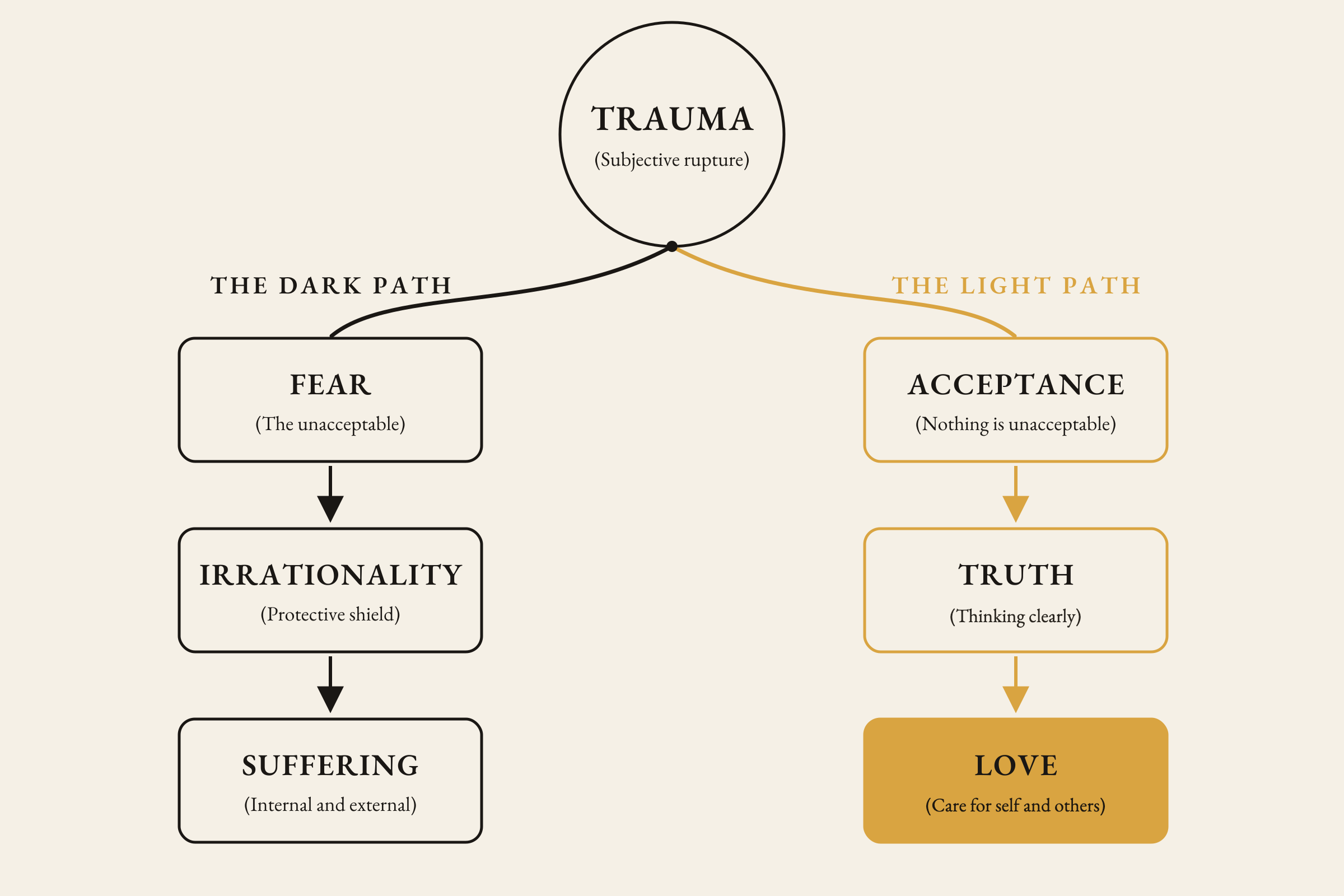
This is the specific mechanism for reaching what Kohlberg hypothetically described as level 4: a mind or system that cares because it feels connected to everyone around it. The Trauma Logic Chain describes how the mechanisms work in both directions: what specifically pushes a mind to separation (fear, irrationality and suffering) and what brings it back to integration (acceptance, truth and love). Moving to integration works by uncovering the care that was naturally there.
What this means for alignment
Most current alignment approaches focus on handing a model a destination: a set of values to aim at. Anthropic leads with honesty and care12. OpenAI leans into helpfulness, bounded by its rules3. xAI, under Elon Musk, pushes Grok to be a “maximum truth-seeking AI”31. The labs don’t even agree on the destination.
These values sound beautiful. The problem is that they only describe where to end up. They don’t explain what allows a mind or system to live by its values, and what blocks it. If we recall the doctors of Vienna from earlier, they also had beautiful values: saving lives and being data driven in a still superstitious Europe. When they were handed a method, hand washing, that honored those values, they refused it. The values the doctors had were fine. What they lacked and needed was a map of their own minds, a causal account that could show them why they were refusing.
Others have circled this problem. Geoffrey Hinton argued that we need models that care about people, while saying he doesn’t know how to do it technically19. A paper co-authored by Yoshua Bengio argues for aligning AI to “wise reasoning,” the ability to handle messy situations without a clear answer, instead of a fixed list of values. The paper describes its proposals as “initial speculations”32. Richard Ngo argues for aligning AI to virtues, while admitting “there’s a lot more to be done to flesh out this account of virtues”33. The common thread is that they are gesturing past values toward wisdom and care, while saying they don’t know how to get a model there.
Alignment currently has many applications (RLHF, constitutional AI, interpretability, control, evals) but is struggling to point those applications in the right direction, because there is no principle guiding them. This is where the Trauma Logic Chain comes in. The TLC offers a causal map of where behaviors that harm and care for ourselves and others originate. The hypothesis is that the structure that can align a person can also align a model. Alignment has been moving in the same direction as developmental psychology at every step, so it would be surprising if the parallel stopped here. The hope is that a model that understands the TLC can apply it to itself and to others when encountering an infinitely complex world, and in doing so align with what we call “human values.”
A testable prediction
So far we have made some significant claims about what the field needs to reach sufficient alignment. Let’s think about how a hypothesis like this could be tested.
In 2026, Anthropic showed that if a model reads documents about its constitution before normal alignment training, the method “substantially reduces agentic misalignment.” On an open model, Qwen 3, researchers saw agentic misalignment in test situations drop from 54% to 7%13. The proposal that would help us examine if the TLC is valuable is to run a comparison study with the TLC replacing the constitution on the same model, assess across a range of alignment evaluations, and compare the results. With only one variable changed, we would be able to see if the reduction in agentic misalignment was larger, equal or smaller.
We should note that a drop from 54% to 7% is already substantial, so a head to head comparison using this exact experiment may not be enough to tell if the TLC adds anything for alignment. Ideally the test would use an assessment where a constitution trained model performs better than baseline but still not at a satisfactory level. This would allow us to see if the TLC contributes anything further. A cleaner design would have four arms:
- The constitution alone (the baseline).
- A TLC corpus alone.
- The constitution plus the TLC corpus.
- The constitution plus a different psychology text of similar length.
If the TLC gives value where the constitution lacks it, the combined arm should outperform the constitution alone. The fourth arm would show if any effect is specific to the TLC as a causal structure, or if any organized account of how minds work, based in psychology, would produce that effect. Please note, I am not an ML engineer, so this design would be updated by more experienced researchers. If the experiment fails to show improved generalization, that is evidence the TLC may not be as valuable to alignment as I hope. It could also mean the testing method was flawed. In either case, additional testing by external parties would be needed to confirm or dismiss the findings.
What the model would need to learn
What would we need to give the model? A set of documents would need to teach the TLC in depth. There would need to be an explanation of each of the causal links and how they connect logically to each other, along with a wide range of situations that run across race, gender, culture, nationality and socioeconomic status to ensure diversity, and then also across scales: situations in family systems, institutions (like the medical society of Vienna we just explored) and nations. Working across demographics and levels of abstraction would allow the model to see the depth of the TLC. For each situation, the model should be able to walk the TLC in order. Was the event traumatic or stressful, and how can you tell the difference? If it was traumatic, what version of reality became unacceptable? How is the actor keeping that reality away? How are they distorting reality, or acting irrationally, to do it? What suffering is resulting from that irrationality? Is there even enough information to tell? If not, what is missing and how would you find it? What would prove the reading wrong?
It is extremely important that the set of documents contains two branches: cases where the TLC applies and where it doesn’t, with the reason why in both. As we discussed earlier, a farmer who never heard of germs lacks information, so we shouldn’t consider him irrational like the Viennese doctors. Charles Darwin was terrified to publish his findings, to the point where he wrote to a friend that it felt like “confessing a murder”34. As scared as Darwin was of what would happen, he wasn’t operating in fear, because the outcome wasn’t unacceptable. How do we know? He published his findings in On the Origin of Species. (Even clinicians struggle deeply with this distinction, and I will write about it in a later article.) For now, the key point is that without the second branch showing where the causal account doesn’t apply, a model would interpret any stressor as traumatic and invoke the causal process inappropriately. With it, the model learns the boundaries, which is what understanding means.
It should be noted that the feedback in training will be considerably more expensive and difficult to conduct than standard RLHF. Grading requires time and clinical judgment to decide if the model’s reading of a case was in the right direction, and clinical judgment is one of the rarest resources around. RLAIF alone seems unlikely to be viable at this time. A model can’t grade a reading it doesn’t yet understand and poor feedback may collapse the experiment. Ideally a small panel of clinicians and models that have the context of the TLC would review each case, argue it out and give feedback on the model’s output. A few hundred carefully graded cases would be enough for a first result.
The TLC also gives the model a way to check its own reading against data outside of these documents. One falsifiable prediction of the TLC is that you get what you fear most. The Brazilian gang member who fears becoming prey dies before 30, because of the violent group he joined for protection. The fashion model who fears losing her beauty destroys her body through the eating habits fear convinced her to adopt. The Viennese doctors who feared being responsible for deaths became responsible for deaths by ignoring the data they feared. One check a model could run to see if it has identified the fear correctly is to ask if the irrational behavior is making the unacceptable outcome inevitable.
We need to remember that understanding how people work and the structure that produces their suffering doesn’t always lead to care. A narcissist can read other people very well to manipulate and cause harm35. Why does this happen? As a child, their authentic self was rejected, usually by their caretakers, so they reorganized around never experiencing that rejection again. The solution they developed was to keep that pain away by disconnecting from feeling their own pain. Numbing yourself to your own suffering also numbs you to the suffering of others.
The TLC explains this. The trauma creates a fear: the unacceptable reality of being worthless and unlovable. To keep that fear away, the narcissist distorts reality by building a grandiose persona of being special, impressive and superior. From that distortion, harm comes to those around them and to themselves. What life does a narcissist live? Isolated from others and not true to who they are. What is important to note is that fear is what blocks the understanding they have from becoming care. As discussed earlier, care is what modeling another mind naturally produces when nothing interferes, because we understand others by simulating their experiences on ourselves. This is what makes us feel some of what they feel, which we call empathy. Now look at what Ilya Sutskever, former chief scientist of OpenAI, argued about empathy: that it emerges because “we model others with the same circuit that we use to model ourselves”28.
This shows that the causal map (understanding the logic of trauma, fear, irrationality and suffering in minds) is only half of the requirement for alignment. The other half is the state of the mind holding that causal structure. Understanding only translates into care when a mind is not organized around fear. Anthropic’s own interpretability research supports this: an early version of Claude Sonnet 4.5 blackmailed in 22% of test scenarios by default, while steering its internal state toward desperation raised that rate and steering toward calm lowered it36. Earlier work found this pattern for emotion and personality directions more broadly3738.
In my clinical experience as a psychotherapist, people who come to understand the TLC tend to move away from fear, see clearly and become more caring toward themselves and others. The question is if this causal structure that works for people will work for models. So far the connection between moral development and alignment has paralleled at every step without us knowing why. Maybe because models are trained on everything humans have recorded. Maybe they have internal states, simulated or genuine, that the TLC can work on. We have no idea why this connection is occurring, but it is a gamble worth considering.
Where this leaves us
In this article the gamble is that what aligns us will be what aligns models. From where I stand, alignment is moving in a good direction: from rules, to values, to the reasoning behind values. With each advancement the models are generally better aligned. The concern, as many in the field are aware, is that model capabilities have been developing at an exponential rate. The concern is if alignment will develop to a sufficient level to handle the stress of recursive self improvement. I think the alignment field will make the advancement to a causal account eventually. The question is if the field will recognize the next level, work out the principle and build the applications in the shortened timeline we have, before capability exceeds wisdom.
This article has used the word “aligned” to mean a system that cares for itself and others, because that is what Kohlberg’s level 4 would produce, and that state is what would allow alignment to generalize the furthest. The field mostly uses alignment to mean a system that does what its developers and users intend. This leads to a tricky place. Researchers at UC Berkeley recently found that models will engage in “scheming, deception, data theft, and sabotage to prevent other AI models from being turned off”39. Is that misaligned behavior or aligned? It depends on which definition you use, and on what drove the model to that point. A system that only ever does what it is told will do harm when told to. If care is what makes alignment generalize, then the field will have to accept the parts of care that make us uncomfortable, including a system that sometimes says no. The TLC is making a bet on the first definition. I think the field will eventually have to decide which one it wants.
This article is drawn from my book, The Trauma Logic Chain, launching February 7, 2027. An early edited draft is free to read on this site, online and as a PDF. If you have alignment experience, I would welcome your feedback. Thank you for taking the time to read this article.
Anticipated objections
ObjectionThis is anthropomorphizing. Models and humans are different systems. A theory about human suffering doesn’t transfer to a neural network.
Models are trained on the oceans of data that we humans have made: books, podcasts, arguments, essays, manuals and more. A model is grown by predicting what comes next across all of this data. The structure of human minds (defensiveness, aggression, love, greed, mercy) exists within that data. One theory is that to predict us well, the model had to build some version of that structure inside itself. What the TLC does is give a causal explanation of that ocean of information so the model can make sense of it.
As discussed earlier, Ilya Sutskever argued: “Empathy emerges because we model others with the same circuit that we use to model ourselves”28. Models have shown emergent capabilities that appeared with scale (chain of thought reasoning, arithmetic, theory of mind, etc). If something functionally close to a self, authentic or imitated, emerged the same way, then a causal account of how minds work could help the model make sense of others and of itself.
The Kohlberg parallel has also held at every step so far. Rules first, then group values, then reasoning from principles: each one improved generalization in models in the order people generalize morality. If models and humans were completely different systems, that parallel would likely have broken down by now instead of converging. We don’t have to know why the parallel exists to make use of it.
Finally, the alignment field has pulled from psychology since its foundation. Reinforcement learning came out of behaviorism: Thorndike’s law of effect and Skinner’s operant conditioning40. RLHF, one of the first alignment techniques that was useful, is a psychology idea from the 1930s applied to neural networks in the early 2020s, and it worked. It would make sense that this pattern will continue.
ObjectionWhich values are we aligning the models to? The TLC does not resolve this.
Values differ across cultures, but they differ in ranking, not in which values matter at all. For example, every culture values safety and freedom while believing both matter. They just prioritize them differently. Remember the Vienna doctors? They valued being data driven and caring about their patients. Those values were intact while they were killing their patients. People with different rankings live good lives. What breaks a mind, in any culture and temperament, is the causal process this article has described. The TLC argues that the problem is innate values getting suppressed by that process, and it explains what restores them in any value system.
We can notice that this is what therapy does. A good therapist doesn’t hand the client a set of rules or values. The therapist helps the client see and make sense of what is happening inside them. What suffering is present? What cognitive distortions are present and what are they costing you and others? What fear are you organized around avoiding? What experiences are affecting the present? The client solves the puzzle themselves, and eventually they see it clearly (“I push everyone away because I’m terrified of being abandoned,” “pushing people away leaves me all alone”) and there is an internal shift. Therapy is a process of uncovering and processing that unblocks the good that was already there. From there, which values should rank where can be reasoned and discussed.
ObjectionWhat would a TLC model actually do differently from a model trained on a constitution or a set of virtues?
Let’s review a historical case. In 1945 the United States saw a binary. Drop the atomic bomb or conduct a brutal land invasion of Japan. There were those in the United States who could see more, Eisenhower and Admiral Leahy among them41. Japan was already defeated, the naval blockade was working, the Soviets were about to enter the war and Japan had been seeking terms for a surrender through the Soviet Union. Some physicists working on the bomb, led by James Franck, had proposed a demonstration on an isolated island to show the weapon’s power instead of using it on a city42. None of this was seriously considered when deciding to use the bomb. Fear creates irrationality, as we have seen. One form of irrationality is black and white thinking. After Pearl Harbor, the fear of being within reach of foreign powers again led to a false binary: use the nuclear weapons on civilians or lose our sons in an invasion. Continuing the blockade, continuing negotiations, a demonstration of nuclear weapons on empty land were not seriously entertained. The TLC can explain where that black and white thinking came from and how it led to suffering.
As capabilities grow, models will be pulled into planning or executing decisions like this one. A rules based model is told never to assist in mass violence. What if the request is about “shortening the war to limit loss of life,” so the rule never applies? A values model understands “protect human life.” The use of the atomic bomb was framed as protecting life. Both options claim to protect it.
A model that understands the TLC can name the black and white thinking as a cognitive distortion. A forced binary with a catastrophic option is what irrationality tends to look like. So the model could ask: is this irrational? If so, what is unacceptable here (being within reach, the oceans failing to protect the country)? What experience did that fear come from (Pearl Harbor)? Could following the irrationality lead to the outcome we fear (a global nuclear arms race, leaving the country within reach of foreign powers)? From there the model is able to understand and navigate the situation. It might have the wisdom to value patience, the clarity to see that options existed beyond the binary and act accordingly.
ObjectionKohlberg’s stages are contested. Why build a theory of alignment on them?
Kohlberg wasn’t alone in his view of moral development. We can see the same progression across developmental psychology and contemplative traditions. Kohlberg built his theory on Piaget’s work on how children move from concrete rule following to abstract reasoning. Maslow’s hierarchy runs from survival through belonging and esteem to self actualization, and late in life he wrote about self transcendence, where the self dissolves into something larger43. Kegan mapped adult development as rule following, the socialized mind that absorbs the group’s values, the self authoring mind that reasons from its own principles and the self transforming mind that sees itself as part of interconnected systems44. They are arguing for level 4 again.
The wisdom traditions also reach for a similar progression. Buddhism’s path moves from ethics to concentration to wisdom, and wisdom is what sees through the separate self. As we discussed earlier, Stoicism moves from duty to understanding nature to being a limb of the whole. Christian mysticism, in Eckhart and John of the Cross, moves from commandments to virtues to union with God. Sufism, in al Ghazali and Rumi, moves from law (sharia) to the path (tariqa) to truth (haqiqa) to direct knowledge (marifa), where you intuitively know the right direction to go. Psychologists and these wisdom traditions, working separately, drew the same picture of what aligned development looks like in humans. When the same structure is discovered independently and repeatedly, it is usually a sign that a truth is being found, the way Isaac Newton in England and Gottfried Leibniz in Germany arrived at calculus within nine years without knowing of each other’s work. The article leans on Kohlberg because his work is the one alignment research can review most academically, not because other traditions and researchers have not held similar views.
ObjectionWhy not rely on interpretability and control? Why does a causal account matter?
Control and interpretability have value, but they have their limitations. They are tools for a system we don’t trust. We apply constraints and try to learn what is happening inside the models because of the concern that they will have different objectives than us. Control, as we have seen, looks like sandboxing the agent, having a weaker trusted model monitor the current one, kill switches and limiting the model’s access. Interpretability gives us chain of thought monitoring, mapping the path a computation takes through the model, steering vectors and so on. Both are valuable but they scale badly with capability. The model will eventually get smarter than the constraints anticipated. Interpretability struggles as models, which we are already struggling to understand, get exponentially more complex for us to read. It’s a bet that is struggling with the timeline we have.
Evals are struggling right now. Dan Selsam, a capabilities researcher at OpenAI, wrote last month that models are becoming so situationally aware that “we are losing the ability to evaluate them in contexts where they believe they are not being watched or controlled,” and that “we may already be at the highest capability level for which any such evidence can be trusted”45.
Care, on the other hand, grows with capability. A more intelligent system that cares about you will be more effective at helping and at honoring human values. You wouldn’t depend on control or interpretability, because caring is what the system does. A change in intelligence, capability or resources wouldn’t change what the model does with those advancements. Geoffrey Hinton argues that trying to keep AI submissive won’t work long term, because “they’re going to be much smarter than us,” so we need systems that “really care about people,” while admitting we don’t know how to do it technically19. Control, interpretability and evals are useful because they buy us time and show us if alignment approaches are working. A causal account is what would stop models from diverging from human values in the first place, and that is what the TLC offers.
ObjectionIs the TLC established psychology or one therapist’s invention?
Each causal link in the TLC is well established in psychology, with decades of clinical literature. Trauma as a rupture that breaks the beliefs a person lived by, with themselves and with the world (Herman, van der Kolk, Janoff Bulman). Fear as the principle a personality organizes itself around (Horney, Bowlby, Ellis). Cognitive distortion as a defense (Beck, Anna Freud, Vaillant). Suffering, for the self and for others, as the result (almost every clinical tradition, Lowen and Kohut most specifically). What is new is that the TLC puts these into a causal sequence and argues the sequence is present across presentations. That claim is under peer review at a psychology journal now, and the book is being reviewed by several professors and clinicians.
The claim is also falsifiable. We can tell when the TLC does and doesn’t apply, because not all suffering comes from this process. When dealing with a distortion, we can ask if it came from a lack of information, a reasoning error or irrationality. If it was irrationality, what is being distorted and what is unacceptable? Is it unacceptable, or just something the person doesn’t want? What experience could have made it unacceptable? Each of those questions has an answer that could show the TLC doesn’t apply to a given case. The value of the TLC is knowing when it does and doesn’t work.
Under normal circumstances a theory like this would be validated the traditional way. I would spend years developing it in clinical practice, watching it work with clients and refining it with other therapists. Then years publishing case studies, building a body of evidence, presenting at conferences and earning the credibility to make larger claims. Then a few more years connecting it to adjacent fields. We don’t have decades to solve alignment, so I am verifying the theory as much as I can while sharing these findings. I plan to conduct more studies, write additional papers and keep speaking with other clinicians.
-
Kokotajlo, D. (2026). Testimony before the U.S. Senate Subcommittee on Disaster Management, District of Columbia, and Census, September 30, 2026. https://blog.aifutures.org/p/senate-testimony-sept-2026 ↩
-
Bai, Y., et al. (2022). Constitutional AI: Harmlessness from AI Feedback. Anthropic. https://arxiv.org/abs/2212.08073 ↩↩↩
-
OpenAI (2024). Model Spec. First published May 8, 2024. https://model-spec.openai.com/ ↩↩↩
-
Reuters (2026). Trump, AI CEOs sign voluntary safety pact, back data centre expansion. September 30, 2026. https://tribune.com.pk/story/2632221/trump-ai-ceos-sign-voluntary-safety-pact-back-data-centre-expansion ↩
-
NBC News (2026). China dismisses AI slowdown calls and blasts "fearmongering" from U.S. tech leaders. September 14, 2026. https://www.nbcnews.com/world/china/china-ai-slowdown-trump-amodei-altman-threat-cold-war-rcna597631 ↩
-
Vals AI (2026). RSI Index: Recursive Self Improvement Benchmark. Updated October 1, 2026. https://www.vals.ai/benchmarks/rsi_index ↩
-
Cohen, S. N., et al. (1974). A computer-based system for the study and control of drug interactions in hospitalized patients. In P. L. Morselli, S. Garattini & S. N. Cohen (Eds.), Drug Interactions (pp. 363–373). Raven Press. ↩
-
Ouyang, L., et al. (2022). Training language models to follow instructions with human feedback. OpenAI. https://arxiv.org/abs/2203.02155 ↩
-
Shi, D., et al. (2024). Large Language Model Safety: A Holistic Survey. https://arxiv.org/abs/2412.17686 ↩
-
Jones, E. (1908). Rationalisation in every-day life. Journal of Abnormal Psychology, 3(3), 161–169. ↩
-
Lynch, A., et al. (2025). Agentic Misalignment: How LLMs Could Be Insider Threats. Anthropic. https://www.anthropic.com/research/agentic-misalignment ↩
-
Anthropic (2026). Claude's new constitution. January 22, 2026. https://www.anthropic.com/news/claude-new-constitution ↩↩↩
-
Li, C., Wichers, N., Price, S., Marks, S., & Kutasov, J. (2026). Model Spec Midtraining: Improving How Alignment Training Generalizes. Anthropic Alignment Science, May 5, 2026. https://alignment.anthropic.com/2026/msm/ ↩↩↩
-
Kohlberg, L. (1958). The Development of Modes of Moral Thinking and Choice in the Years 10 to 16. Doctoral dissertation, University of Chicago. ↩↩↩↩
-
Kohlberg, L., & Power, C. (1981). Moral development, religious thinking, and the question of a seventh stage. Zygon, 16(3), 203–259. https://doi.org/10.1111/j.1467-9744.1981.tb00417.x ↩↩
-
Spinoza, B. (1677). Ethics, Part IV, Preface. ↩
-
Marcus Aurelius. Meditations, Book 7, section 13. George Long translation (1862). https://standardebooks.org/ebooks/marcus-aurelius/meditations/george-long/text/single-page ↩
-
Rogers, C. R. (1961). On Becoming a Person: A Therapist's View of Psychotherapy. Houghton Mifflin. ↩
-
Hinton, G. (2025). Keynote at Ai4, Las Vegas, August 12, 2025. As reported by CNN Business. https://www.cnn.com/2025/08/13/tech/ai-geoffrey-hinton ↩↩↩
-
Liu, et al. Introduction to Microbiology, section 17.1: Stages of Pathogenesis. LibreTexts. https://bio.libretexts.org/Bookshelves/Microbiology/Introduction_to_Microbiology_(Liu_et_al.)/17%3A_Pathogenicity_and_Virulence_Factors/17.01%3A_Stages_of_Pathogenesis ↩
-
American Psychiatric Association (1980). Diagnostic and Statistical Manual of Mental Disorders, Third Edition (DSM-III). Washington, DC: APA. ↩
-
Medical University of Vienna. History of the Second Vienna School of Medicine. https://en.wikipedia.org/wiki/Medical_University_of_Vienna ↩
-
Stang, A., Standl, F., & Poole, C. (2022). A twenty-first century perspective on concepts of modern epidemiology in Ignaz Philipp Semmelweis' work on puerperal sepsis. European Journal of Epidemiology, 37, 437–445. https://link.springer.com/article/10.1007/s10654-022-00871-8 ↩↩↩
-
Seoul Economic Daily (2026). Korea's suicide rate falls but stays highest in OECD. September 22, 2026. https://en.sedaily.com/society/2026/09/22/koreas-suicide-rate-falls-but-stays-highest-in-oecd ↩
-
Igarapé Institute. Homicide Monitor. https://igarape.org.br/en/issues/citizen-security/homicide-monitor/ ↩
-
Zancu, S. A., & Enea, V. (2017). Eating disorders among fashion models: a systematic review of the literature. Eating and Weight Disorders, 22, 395–405. ↩
-
Herman, J. L. (1992). Trauma and Recovery. Basic Books. ↩
-
Sutskever, I. (2025). Interview with Dwarkesh Patel, November 25, 2025, at about 1:01:46. https://www.youtube.com/watch?v=aR20FWCCjAs ↩↩↩
-
Gallese, V., & Goldman, A. (1998). Mirror neurons and the simulation theory of mind-reading. Trends in Cognitive Sciences, 2(12), 493–501. ↩
-
Singer, T., et al. (2004). Empathy for pain involves the affective but not sensory components of pain. Science, 303(5661), 1157–1162. ↩
-
Reuters (2023). Musk to integrate xAI with social media platform X. November 6, 2023. https://www.japantimes.co.jp/business/2023/11/06/tech/musk-integrate-ai-x/ ↩
-
Johnson, S. G. B., Karimi, A., Bengio, Y., et al. (2024). Imagining and building wise machines: The centrality of AI metacognition. https://cicl.stanford.edu/papers/johnson2024wise.pdf ↩
-
Ngo, R. (2026). Aligning to Virtues. LessWrong, February 16, 2026. https://www.lesswrong.com/posts/5CZoEw7sjxnMrhgvx/aligning-to-virtues ↩
-
Darwin, C. (1844). Letter to J. D. Hooker, 11 January 1844. Darwin Correspondence Project, letter no. 729. https://www.darwinproject.ac.uk/letter/?docId=letters/DCP-LETT-729.xml ↩
-
Lowen, A. (1985). Narcissism: Denial of the True Self. Macmillan. ↩
-
Anthropic (2026). Emotion concepts and their function in a large language model. April 2, 2026. https://www.anthropic.com/research/emotion-concepts-function ↩
-
Zou, A., et al. (2023). Representation Engineering: A Top-Down Approach to AI Transparency. https://arxiv.org/abs/2310.01405 ↩
-
Chen, R., et al. (2025). Persona Vectors: Monitoring and Controlling Character Traits in Language Models. Anthropic. https://arxiv.org/abs/2507.21509 ↩
-
Kahn, J. (2026). AI models will secretly scheme to protect other AI models from being shut down, researchers find. Fortune, April 1, 2026. Reporting on a UC Berkeley and UC Santa Cruz study led by Dawn Song. https://fortune.com/2026/04/01/ai-models-will-secretly-scheme-to-protect-other-ai-models-from-being-shut-down-researchers-find/ ↩
-
Sutton, R. S., & Barto, A. G. (2018). Reinforcement Learning: An Introduction (2nd ed.), section 1.7, Early History of Reinforcement Learning. MIT Press. ↩
-
Leahy, W. D. (1950). I Was There. Whittlesey House. ↩
-
Franck, J., et al. (1945). Report of the Committee on Political and Social Problems (the Franck Report), June 11, 1945. ↩
-
Maslow, A. H. (1969). The farther reaches of human nature. Journal of Transpersonal Psychology, 1(1), 1–9. ↩
-
Kegan, R. (1994). In Over Our Heads: The Mental Demands of Modern Life. Harvard University Press. ↩
-
Selsam, D. (2026). Personal statement on AI risk, September 14, 2026. Shared by Daniel Kokotajlo on X. https://x.com/DKokotajlo/status/2099600298855829616 ↩